
Assyria: Second Edition - A Solo Review
29 Mar 2026, reviewed by KristofIn a hurry? Here’s my quick take!
Assyria gives you a bit over an hour of tough and impactful decisions. You’ll be bidding for resources and turn order, spreading your huts over the map, building ziggurats to uncover bonuses on your player board that add some more strategic direction to the otherwise more tactical flow of the game, and grabbing various opportunities to score points. Floods periodically reset the board, forcing you to adapt.
The automa mimics a player pretty well and does so with an incredibly low amount of overhead, all using a single deck of cards. This makes Assyria an excellent choice for the solo gamer looking for a fun blend of tactical and strategic decisions and just enough variation to keep things interesting.
At a glance
- Solo play time: 60–75 minutes
- Setup / Teardown: 10 / 5 minutes
- Complexity: medium
- Solo system: automa opponent you have to beat, it is driven by a deck of cards with 4 levels of difficulty
How it plays
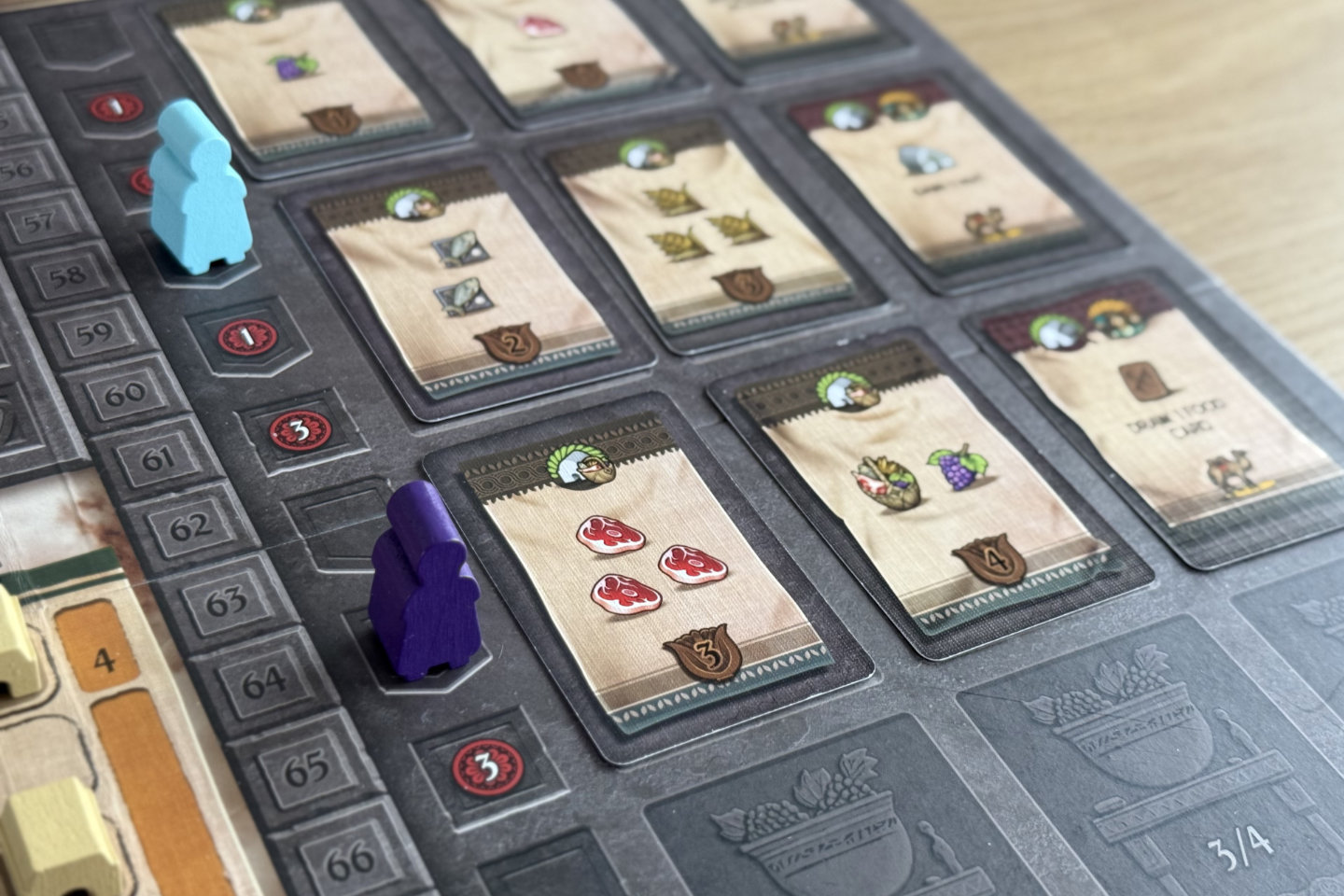
Assyria presents you with meaningful decisions in every phase of the game. Each round begins with an auction for food and favour cards, where the most attractive options usually come at the cost of going later in turn order. Right off the bat, that forces you to make an important choice that will have its consequences for the rest of the round: do you secure the better resources, or is it more important that you get to act before your opponent in the rest of the round?
Extra tension is added by the possibility to overbid by paying victory points. Do you play it safe and immediately pay 3 victory points to prevent being overbid, or do you take a chance by not paying anything and hoping your opponent doesn’t have their eye on the same food cards?
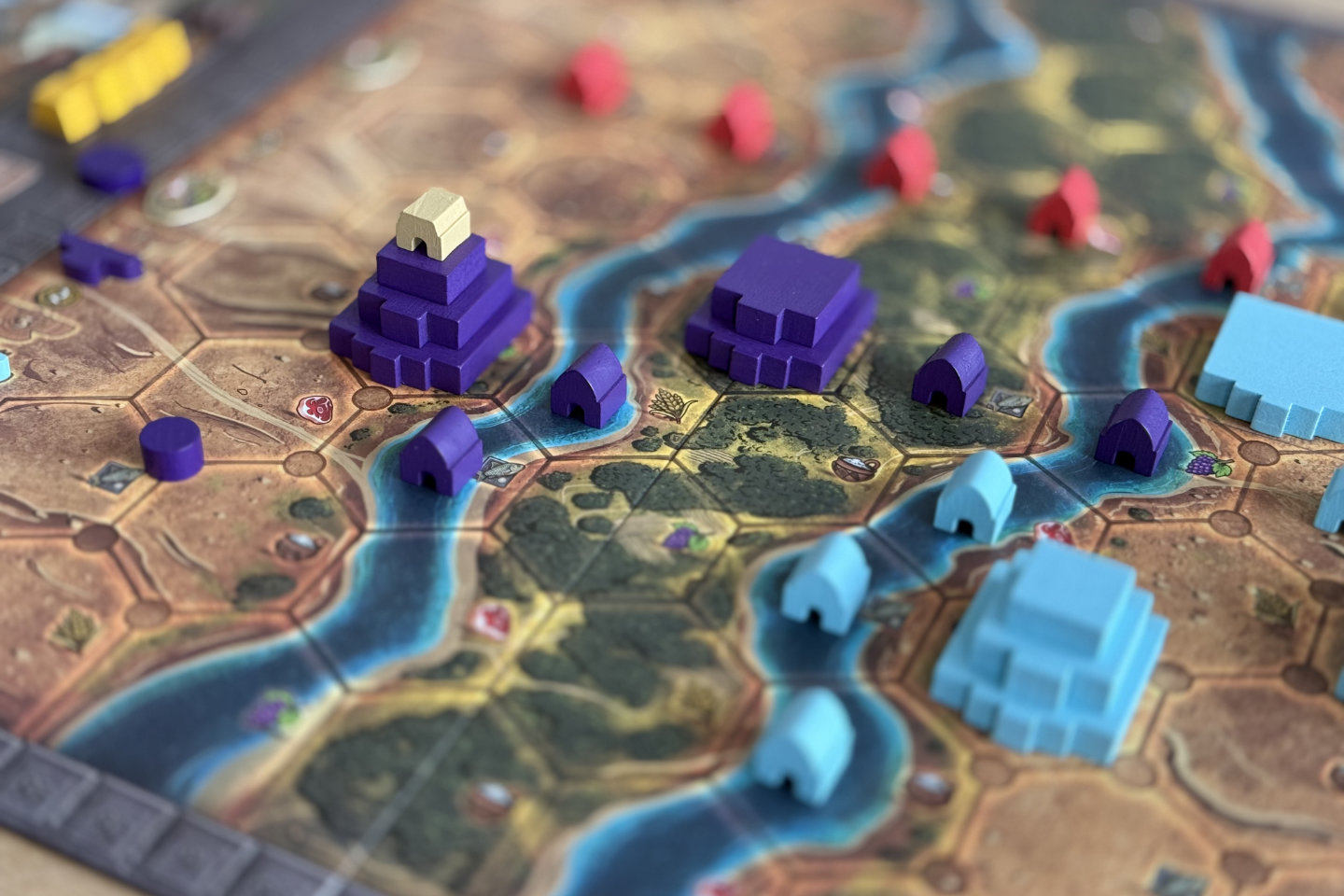
The rest of the round is filled with more of those choices with an inherent tension to them. You’ll spend it placing huts on the map, deciding what you need most: locations on the river provide camels to fuel actions later in the round, while others generate victory points.
The catch is that it all depends on whether you can actually feed your huts, mostly using the food cards you obtained earlier in the auction. That’s a constant pressure, because any hut you can’t feed is removed before it provides any benefit.
After that, you’ll turn your camels into actions, still following the same turn order. One of the key things you can do is build multi-layered ziggurats. Each level you build is taken from your player board, revealing bonuses that make certain actions stronger or cheaper as the game progresses. This allows you to specialize in a particular direction. You might focus on generating more gold, or set yourself up to secure more food for future rounds. It adds a layer of strategy on top of the more tactical choices of each round.
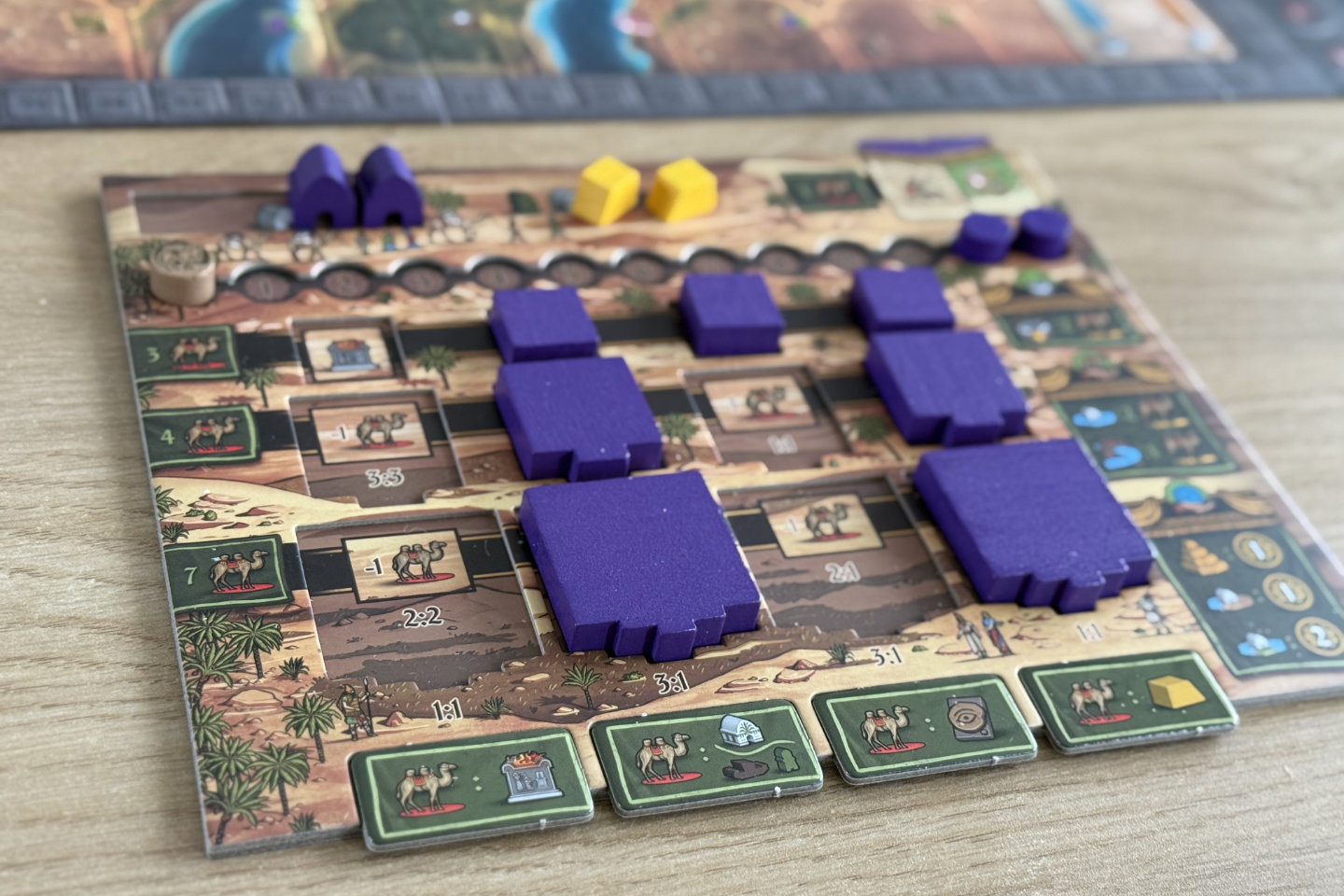
There are six rounds of this in the game and after every three rounds a flood happens. Apart from some scoring taking place, these flood rounds are important because they reset parts of the board back to the initial state. The most thematic and impactful reset is that all huts on river spaces are removed, opening up the board again.
After six rounds and two floods, the player who has managed to squeeze the most victory points out of those moments of tension and tough choices is declared the winner.
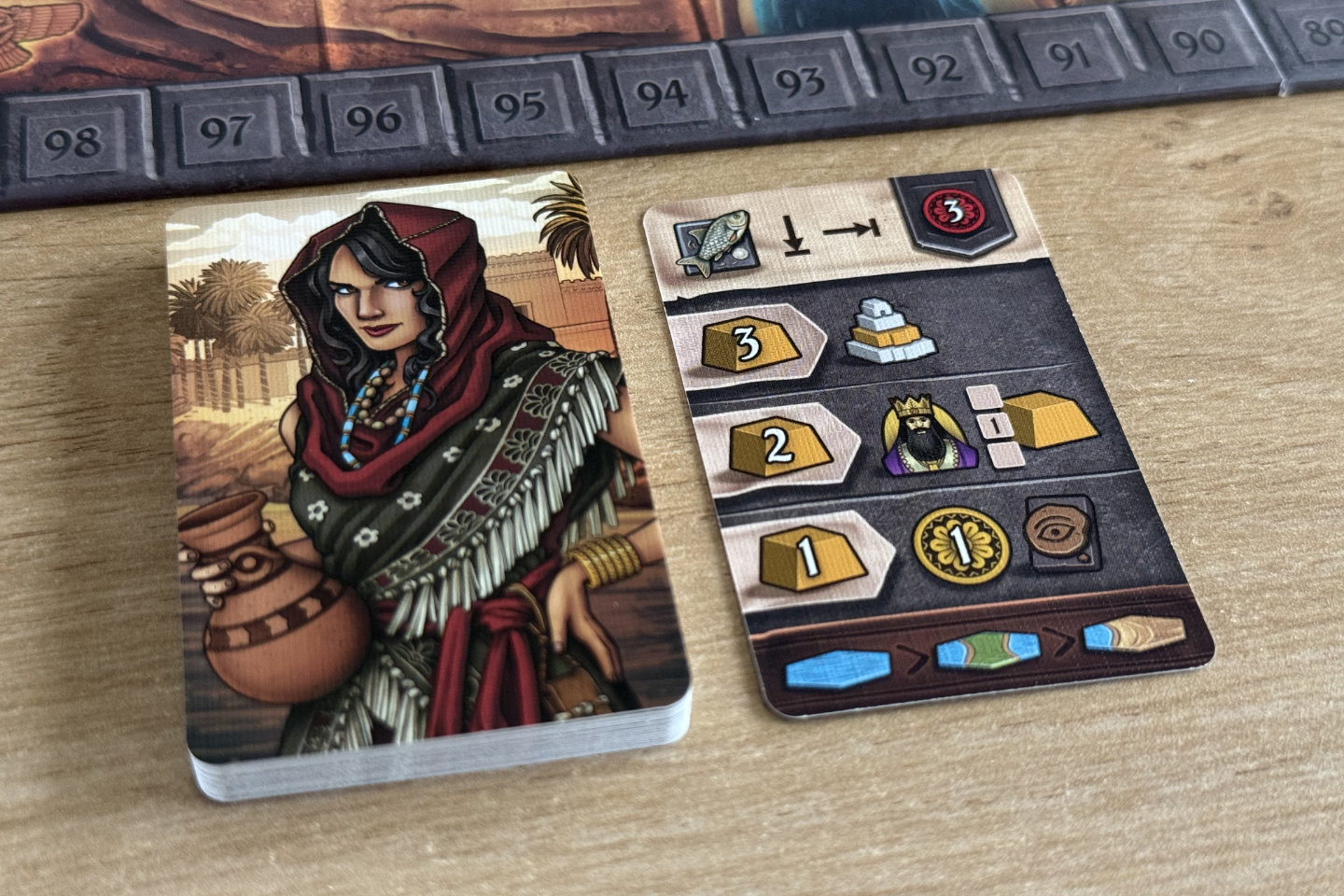
You may have noticed I haven’t mentioned the automa so far. That’s because it does almost everything you do and feels like a real player, but with an incredibly low amount of overhead. All of its actions and choices are driven by a single automa deck. Whenever it needs to take a decision, like where to bid on in the auction, where to place a hut, where to spend gold, … you simply flip one card and all the information is on there. You might have to flip over 10 cards in a round, but because each takes only a few seconds to read and execute, it makes the automa impressively streamlined. It’s really amazing how smoothly it runs, especially considering how many decisions this game asks you to make.
The friction
Not everything lands equally well in solo, though:
- While the automa behaves pretty much like a real player, one major exception is that it does not need to feed its huts. This usually means the automa will have almost all its huts on the board by the final two rounds, causing it to gain a lot of points from them. That asymmetry can feel a bit unfair, especially when you are struggling keeping your huts alive to generate enough points or camels.
- It can happen that all of the food cards in the auction phase are pretty bad. That can feel crippling for you as it directly influences how many huts you’ll be able to feed. In a multiplayer game this affects everyone, but in a solo game the automa is not bothered by that, which makes these moments, even if they’re rare, feel extra punishing.
Why I’d keep playing
I find the core loop and the choices you have to make in this game very enjoyable. Figuring out the optimal way to place your huts so you can get the things you need, be it victory points or camels, has something really satisfying to it. The same goes for building ziggurats since that unlocks bonuses that makes corresponding actions stronger or cheaper, which gives you a sense of progression as the game goes on.
The combination of tactics, strategy and the need to respond to how the game develops makes each session different enough from the previous one. Focusing on a single ziggurat or trying to build all four of them makes for a very different game, yet I’ve found both approaches to be equally viable.
Closing thoughts
I have to admit that I like Assyria a lot more than I thought I would. At a glance, it looks like a fairly static game where you slowly expand across the map, but in practice it’s much more dynamic than that. Because huts get removed, either from not being fed or by floods, the board state is constantly shifting. That’s something you need to recognize and embrace. If you approach Assyria as a game where you need to steadily increase your presence, it can quickly become frustrating. It’s more about having the right number of huts in the right places at the right time.
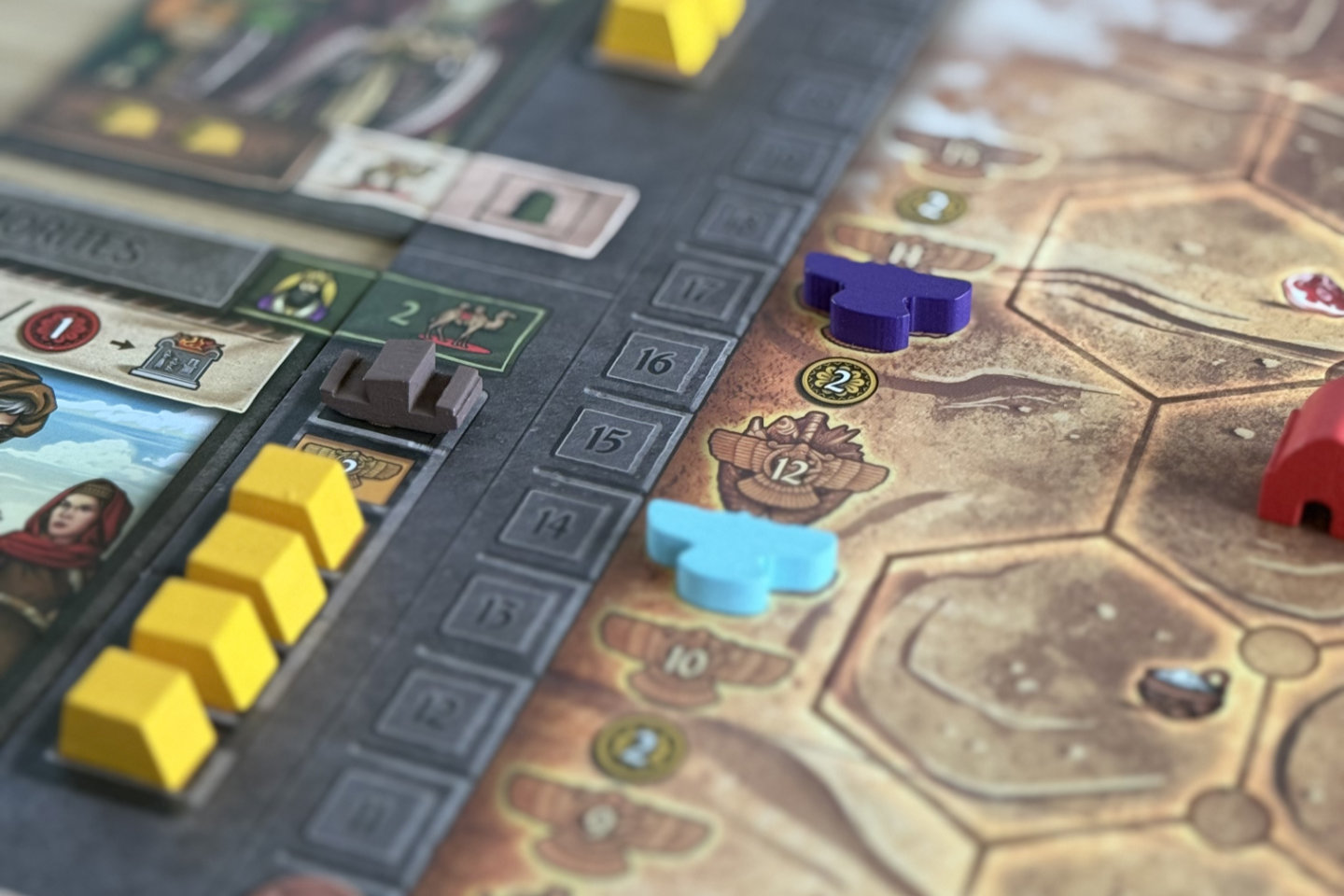
From a solo standpoint, I am really impressed with the automa. With such a decision-heavy game, you wouldn’t be wrong to expect a complicated bot with elaborate flowcharts and priority queues. In all fairness, I’m pretty sure that’s how some solo designers would indeed approach it. Instead, Shem Phillips has found a way to keep it as simple as possible without sacrificing how the automa feels as an opponent. It might make slightly better decisions with a more complex system, but the extra overhead wouldn’t be worth it. This really is the best of both worlds.
If you enjoy solo games that constantly force you to adapt and rethink your plans, Assyria is well worth your time. It’s a game that rewards careful play and flexibility rather than thinking too far ahead, and that makes it feel fresh across multiple sessions. It won’t be for everyone, especially if you prefer more predictable or steadily growing engines, but if you like tense, decision-heavy solo games with a smooth automa, this one is easy to recommend.